
Conservatives seem to like to lay claim to people who during their life were by no means conservative in life, once they die. JFK is one example. Conservatives also seem to have tried to claim this giant of the abolitionist movement in the 19th century. See this for an example.
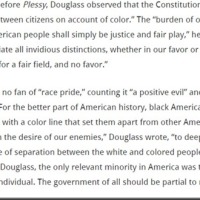
It quotes Douglass extensively, but a bit selectively

It is hard for me not to think though that those quote were mostly a reaction to white supremacist views. This Douglas quote from 1869 is suggestive:
- Heretofore, the policy of our government has been governed by race pride, rather than by wisdom. Until recently, neither the Indian nor the negro has been treated as a part of the body politic.
Douglass lived in a time when white supremacist views were widespread, and following the Civil War were the basis rolling back much of white the war had done to advance equality. I think it a real reach to conclude that Douglass’ concern about racial pride motivating taking the vote away from those of African descent, means he would be opposed to a shared pride in reclaiming that vote and other rights, and standing to not lose them again.
Also Douglass expressed views that many conservatives seem to be enraged by today. When an African American player shows less than total enthusiasm for the national anthem-by wanting to honor issues where the country has not lived up to it promise-during it, we have our conservative President demanding they be fired or worse. That said how would President Trump react to these words from Douglass:
- What, to the American slave, is your 4th of July? I answer: a day that reveals to him, more than all other days in the year, the gross injustice and cruelty to which he is the constant victim. To him, your celebration is a sham; your boasted liberty, an unholy license; your national greatness, swelling vanity; your sounds of rejoicing are empty and heartless; your denunciations of tyrants, brass fronted impudence; your shouts of liberty and equality, hollow mockery; your prayers and hymns, your sermons and thanksgivings, with all your religious parade, and solemnity, are, to him, mere bombast, fraud, deception, impiety, and hypocrisy — a thin veil to cover up crimes which would disgrace a nation of savages. There is not a nation on the earth guilty of practices, more shocking and bloody, than are the people of these United States, at this very hour.
This would not please Mr. Trump, I’ll wager.
Maybe conservatives would say I’m taking this out of context. Douglass said these words in 1852, and slavery was firmly established in much of the United States at the time. Today it is gone, so maybe the quotes about bringing the races together are all that apply.
I have trouble thinking that. In the memory of people still alive, successful blacks were acted viciously in Tulsa in the 1920’s. I think I know a fair amount of US history, but only became aware of this relatively recently. Revisionist history to make the white south look better was propagated and still exists. Monuments built to honor those who fought to preserve slavery and that marked the rollback of black rights in the Jim Crow south still exist and are militantly defended. Blacks are much more likely to be subject to the death penalty, prosecutors work diligently to exclude blacks from juries, and policing seems a lot more aimed at people of color.
If Douglass were alive I think he’d stand behind views that conservatives would not accept.





 Brucetheeconomist's Blog
You must be logged in to post a comment.